More than parking: how mobility is changing in professional services
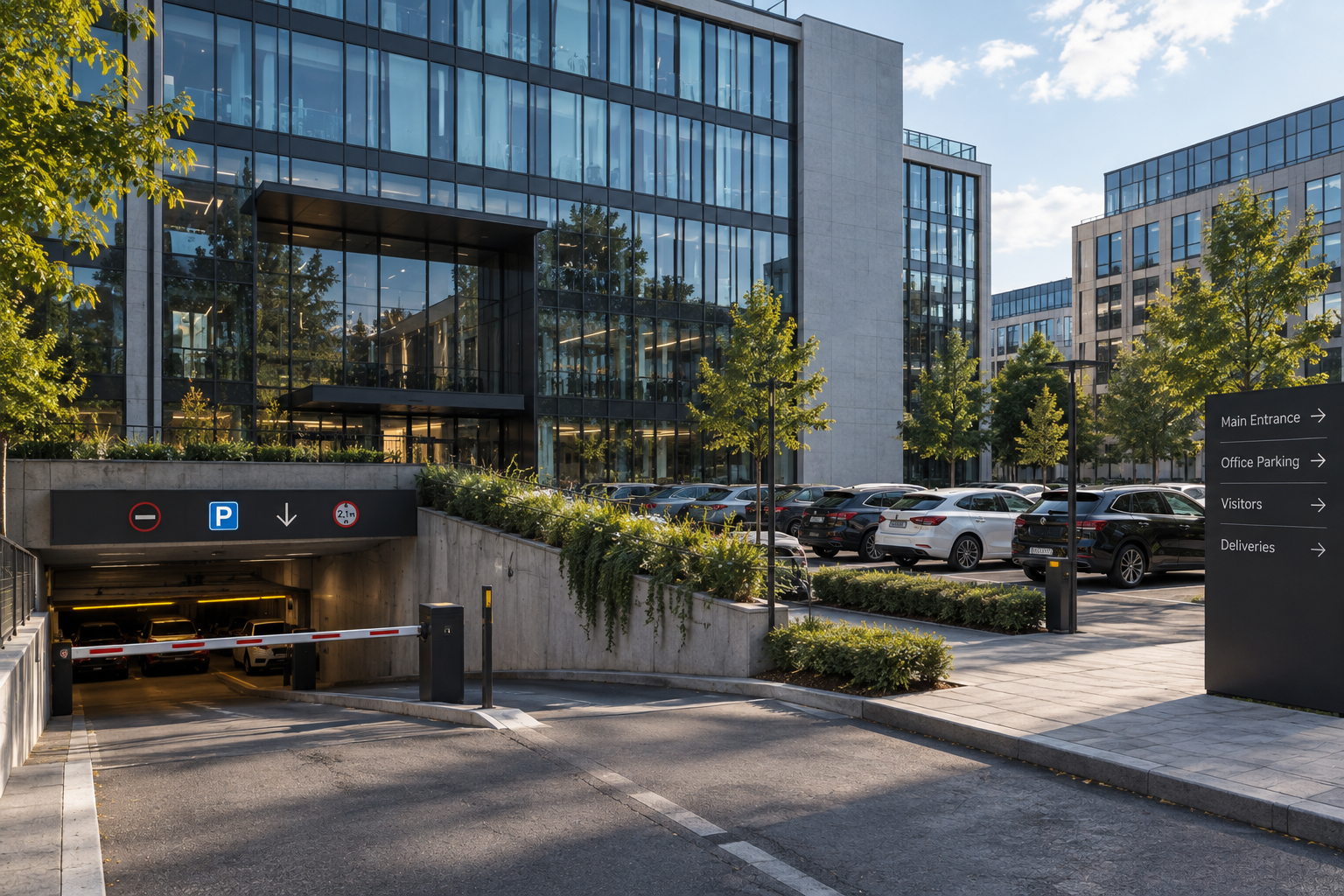
Parking, charging and access are becoming one connected operational question for consulting, legal, audit and financial services firms.
A consulting, legal, audit or financial services firm may not have parking at the heart of its business. Yet its people rely on it every day.
Employees travel to client sites, move between offices, work in hybrid patterns, use company cars, charge electric vehicles and welcome visitors. The larger the organisation and the more locations it operates, the more individual processes are connected to these everyday movements.
That is why, in professional services, mobility is increasingly becoming an operational issue.
Why is workplace mobility becoming more important?
Hybrid working has fundamentally changed how offices are used.
Not everyone arrives every day, not everyone arrives at the same time and not everyone needs the same parking space. At the same time, the number of electric vehicles continues to grow, making workplace charging an increasingly important part of office infrastructure.
A car park is therefore no longer simply a place where vehicles are left. It is connected to access control, space booking, charging, visitor management, cost allocation and the administration behind them.
When these processes are managed through separate systems, complexity quickly becomes part of everyday operations.
The challenge is not necessarily the number of parking spaces
An office building can have enough parking spaces and still create a poor employee experience. Everyone may look for the same spaces in the morning, while other spaces remain unused.
Visitor parking can require a separate process, while EV charging usage can be difficult to track. The same applies to company cars: parking and charging costs may appear across different providers, invoices and reimbursement processes.
The challenge, therefore, is not simply providing the infrastructure. It is operating it effectively.
What does this mean in practice?
For a professional services organisation, workplace mobility consists of several connected areas:
- Office parking, where employee and visitor access can be managed.
- Parking space booking that adapts to hybrid working.
- Digital access, for example through number plate recognition.
- EV charging, from workplace infrastructure to usage and cost management.
- Business-purpose parking and charging connected to corporate fleets.
- Administration and reporting that provide visibility into how the infrastructure is actually being used.
These areas can each be managed separately. But the more systems involved, the greater the potential for manual work and the less visibility an organisation may have across its mobility operations.
Bringing together what was previously managed separately
This is where Parkl’s approach starts. Rather than treating mobility simply as a parking or charging service, Parkl positions itself as a Mobility Operations Platform: a unified system in which parking, charging and access can be connected.
This means infrastructure, digital systems and users can be brought into the same operational layer.
Parkl Office, for example, supports parking space management, booking, visitor parking and digital access. EV charging can be integrated into the same environment, while energy use and charging transactions can also be managed.
Parkl Fleet addresses the other side of corporate mobility: business-purpose parking, EV charging, roaming and the related corporate administration in one system. Its roaming solution provides access to public charging networks across several countries in the region, with consolidated billing by country.
Why does this matter in 2026?
As electric mobility expands and expectations around workplace infrastructure increase, parking and charging are becoming harder to manage as isolated services.
Companies do not necessarily need more tools. They need better visibility, fewer manual processes and greater control.
That is the principle behind Parkl’s approach: making complex mobility infrastructure easier to operate. Because ultimately, mobility is not just about how many parking spaces or charging points a company has. It is about how effectively it can operate them.
Sources
Tags
Also available in:
Related articles

More than parking: Parkl's digital infrastructure at the BudaPart GATE
As part of the collaboration between Parkl and CPI Property Group, Parkl took over the EV charging infrastructure of the BudaPart GATE office building, followed by the operation of the parking system in 2025.

Aréna Corner: Parkl smart office solutions in the heart of Budapest
Nearly two years ago, at Arena Corner — part of CPI Hungary's portfolio — Parkl began a collaboration to create a smoother, smarter and future-proof mobility experience for the entire office community.

How to make your office building greener and increase your ESG score
Most businesses know that environmental responsibility is key to sustainable operations — but your office building also plays a crucial role in shaping your carbon footprint and ESG performance.